Welcome to Kuraĝo, a new blog covering addiction, trauma, recovery, wellness, and the search for meaning.
While Kuraĝo is hosted by Driftwood Recovery—and will feature conversations with Driftwood’s clinicians, dieticians, physical therapists, and canine client support specialists—it’s not necessarily a blog about Driftwood. This blog is for everyone, and we want it to include a wide variety of perspectives.
Alongside explainers on “Dialectical Behavioral Therapy” and “opiate hyperalgesia,” you’ll find movie recommendations, recipes for non-alcoholic cocktails, meditations, and links to whatever else we found interesting during a given week.
Whether you’re taking your first awkward steps toward sobriety, trying to learn more about the challenges that a friend or family member in residential treatment is facing, or just looking for strategies for weathering the daily stresses of life, we hope you’ll find something of value here.
For all of the above plus occasional cat memes, follow us on Twitter.
If you’re interested in contributing to the blog—or you know about something we should be discussing here—drop us a line at: kurago (at) driftwoodrecovery.com.
We’re glad you found us.
Despite the popularity of drugs like amphetamines and marijuana in Texas, alcohol remains the substance of choice for most users. Further, alcohol abuse statistics indicate that this fondness develops early. In fact, just over half of Texas secondary students have experimented with alcohol according to the 2014 Texas School Survey. 21.2% percent of them reported drinking at least once within the last month.

The Risks of Youth Alcohol Abuse
Dealing with alcoholism during the formative years of adolescence and young adulthood can have effects that last for decades. Alcohol addiction can impact a person’s ability to develop and maintain relationships as well as their performance in school or at work.
Alcohol abuse statistics show that the earlier a person starts drinking, the more likely they are to develop alcohol addiction down the road. Researchers believe that alcohol affects teens’ developing brains, essentially programming them to want more alcohol.
The Long-Term Dangers of Alcohol
With alcohol so readily available, and legal for adults over 21, many don’t believe it to be that dangerous. However, regular alcohol abuse can lead to a variety of health conditions. While young people often don’t have concerns about long-term consequences, they should be aware that the habits they form now can have severe impacts on their quality of life down the road.
Conditions that the long-term abuse of alcohol can cause include:
- Cancer
- Cardiovascular disease
- Cirrhosis
- Pancreatitis
- Depression
- Dementia
- Nerve damage
The best way to avoid these outcomes is to seek alcoholism treatment as early as possible.
Don’t Let Texas Alcohol Abuse Statistics Scare You
While these alcohol abuse statistics may seem bleak, things are actually much better than they used to be. In fact, when the Texas School Survey began in 1990, 81% of secondary students reported using alcohol experimentally. In 2014, this number was closer to 50%.
As you can see, things are improving, but there’s still work to do. Decreasing the rate of alcohol use in teens can prevent the need for alcohol rehab once they become adults. However, if the need for treatment arises, comprehensive care is available.
Alcohol Abuse Treatment at Driftwood Recovery
Driftwood Recovery in Driftwood, Texas features an 85-acre campus, giving you the perfect environment to recover. It doesn’t matter whether you’re dealing with alcohol abuse, an addiction to another substance, or even chronic pain — Driftwood can help you heal. Our expert staff can guide you toward sobriety, no matter when your addiction began.
We provide a variety of addiction therapies, including:
- Yoga therapy
- Cognitive behavioral therapy
- Experiential therapy
- Family therapy
- Group therapy
- Trauma therapy
- Psychotherapy
While certain Texas alcohol abuse statistics can be discouraging, use them as fuel for change. Reaching out for help is a courageous decision and one that you are capable of making. For more information about alcoholism treatment, reach out to us at 866-426-4694.
Therapeutic recreation is one therapy option that drug rehab facilities use. But what is therapeutic recreation? Furthermore, what are the benefits that can come from the use of this effective tool?
What Is Therapeutic Recreation?
Recreational therapy is the use of various leisure activities to provide healing from difficult problems. Leisure activities can help improve a person’s mental, emotional, and physical health. However, what is therapeutic recreation used for in the rehab setting? The goals of recreational therapy often center around building effective relationships and problem-solving skills, as well as gaining more confidence.
What Benefits Come from Therapeutic Recreation?
What is therapeutic recreation designed to do for those struggling with addiction? The answer to this question lies in understanding the benefits that this treatment can offer. Consider the following advantages this therapy provides:
Reduction in Stress
Although we all have stress every day, those facing addiction often have a hard time dealing with it. Of course, leisure activities can be relaxing. They can also provide a sense of fulfillment that can make life more enjoyable.
Positive Relationships
Some leisure activities involve other people. This can lead to the development of meaningful relationships that can last for many years. These activities can improve trust-building behaviors, communication skills, and other facets of socialization.
Self-Esteem
Proper self-esteem can be lacking in those struggling with addiction. Some leisure activities can allow a person to eventually develop a healthy sense of pride. As a result, many different areas of life can improve.
Less Depression and Anxiety
It is common for people with an addiction to become depressed or nervous as well. Recreational activities can lower the risk of these complications.
Creating an Effective Treatment Plan
Therapeutic recreation can involve many types of activities. For example, outdoor activities, arts and crafts, fitness therapy, and similar functions can come together to form an effective treatment plan. Recreation therapy elements combine with counseling, group therapy, and behavior therapies to form comprehensive treatment plans.
How to Motivate Someone You Love
Many people who struggle with addiction resist getting help. Even though they do not want to keep suffering, they might be afraid that the treatment process will be too hard. Fear and anxiety surrounding treatment are normal. You might be able to motivate your loved one by being there to listen to his concerns. Offering reassurance that treatment is a worthwhile endeavor may be the best thing you can do for your loved one’s future success.
Finding a Quality Treatment Facility
Do not feel overwhelmed when looking for a rehab center. Driftwood Recovery is a pain and substance abuse rehab center in the Driftwood, Texas area. The in-depth programs offered by Driftwood can provide you with relief from addiction-related problems. By performing a complete evaluation of everyone, each person will find that their unique treatment needs are met.
Don’t let an untreated addiction ruin the quality of your future life. You can recover from addiction by getting help from a facility that provides quality treatment options like therapeutic recreation. Call Driftwood Recovery at 866-426-4694 to learn more about how to get started on the road to recovery.
It’s very common for people who struggle with depression to turn to drugs as a way to self-medicate. The other issue is that there are also people who begin to develop symptoms of depression due to their substance use. This is why when you’re seeking treatment for your addiction, it’s important to go to a dual diagnosis facility. Here, depression and drug abuse both receive attention to give you the best chances of staying clean.
How Depression and Drug Abuse Starts
For many people, symptoms of depression develop, and they may not even know what’s happening. It’s common for people to begin experiencing symptoms of depression and feel extremely lost and alone. It’s difficult when you’re struggling and feel like everyone around you is happy and enjoying life while you’re not. Some of the most common symptoms of depression include the following and more:
- Lack of motivation
- Not finding pleasure in things you used to enjoy
- Excessive weight loss or weight loss
- Feelings of hopelessness
- Feelings of emptiness
People turn to drugs to get a feeling, get rid of a feeling, or have an escape, which is why depression and drug abuse go together. Your feelings of emptiness may have you turn to drugs as a way to experience some type of emotions. You may also be someone who doesn’t feel pleasure, so the dopamine you get from drugs is all you know. The issue is that this only leads to more problems, which is why you need depression and anxiety treatment.
Treating Depression and Drug Abuse
If you’re struggling with depression and have an addiction to drugs, dual diagnosis treatment can help. In treatment, you’re going to work with licensed professionals who will assess your depression and find solutions. Working with a therapist will help you get to the source of your depression so you can begin using tools to overcome it. In some situations, there might be non-narcotic depression medications that can help you get to a place where your life begins to improve.
It’s important that the treatment center you go to can treat your depression because it’s hard to stay sober while depressed. Another great aspect of treatment is being in the company of others who are struggling with addiction. While in your depression and addiction, you can feel like nobody understands what you’re going through. Surrounded by your peers, you’ll find the incredible support you need to gain hope that you can recover.
Taking the First Step
Driftwood Recovery is an addiction treatment center that can help you on the road to recovery. If you’re ready to take the first step towards beginning a new chapter in your life, let us help. Our facility sits on 85 acres of land, so we offer you a beautiful setting to focus on yourself and begin recovery. Some of our programs include:
- Family program
- Inpatient rehab
- Intensive outpatient program (IOP)
- 12 Step program
Find out more by calling Driftwood Recovery today at 866-426-4694.
Your loved one’s drug abuse is out of control. You’ve tried to help, but there’s no interest. Maybe you’re not the only family member or friend who’s been working with the person. Here’s how to help a drug addict who doesn’t want help.
Understand Addiction
It sounds deceptively simple. If your loved one would just quit, life would be better for everyone. However, addiction is a disease of the brain. It’s not something that she can turn on and off at will.
There’s a good chance that this individual would love to quit using today. Symptoms of withdrawal are likely what keeps the person coming back to using. Then there are the underlying reasons that might have contributed to drug abuse. Even if you learned how to help a drug addict who doesn’t want help today, these issues are still there.
Until someone deals with them, they’ll result in repeated relapses. These thoughts may have been going through your loved one’s mind. They come out as not wanting anything to do with quitting. However, there are ways around that.
How to Help a Drug Addict Who Doesn’t Want Help – Yet
An intervention with those closest to the individual is a good way of getting your point across. The goal is to have your loved one commit to enrolling in a rehab program. Interventions don’t work when everyone’s airing their grievances. This meeting shouldn’t be about finger pointing.
Instead, it should focus on helping the individual recognize that there’s a group of people that care. Express that you want to form a support network. Outline how you would commit to helping the person after he completes a rehab program. It’s a good idea to enlist the assistance of an intervention specialist.
Educate Yourself about Rehab First
Before trying to help your loved one, know what rehab’s like. For example, there are different treatment delivery methods. Examples include:
- Residential stays that allow your loved one to live at the facility while undergoing treatment
- Extended care, which is essential for someone who has a difficult time healing in 30 days
- Partial hospitalization that lets the person spend time at the facility during the day and return home at night
- Intensive outpatient treatment is a part-time approach to rehab that works well for qualified participants
- 12 Step program attendance after discharge for relapse prevention
Sometimes, people don’t know what to expect from treatment. They might say no to it simply because they’re afraid of living somewhere that they don’t want to be. By explaining how the process works, you help dispel some of the myths and fears they have. Start learning how to help a drug addict who doesn’t want help with a call to a rehab facility.
Case in point is Driftwood Recovery. Caring therapists there routinely help people just like your loved one overcome a variety of addictions. They customize treatment protocols to meet the needs of program participants. Call 866-426-4694 to find out how it works.
Prescription Drug Abuse Statistics
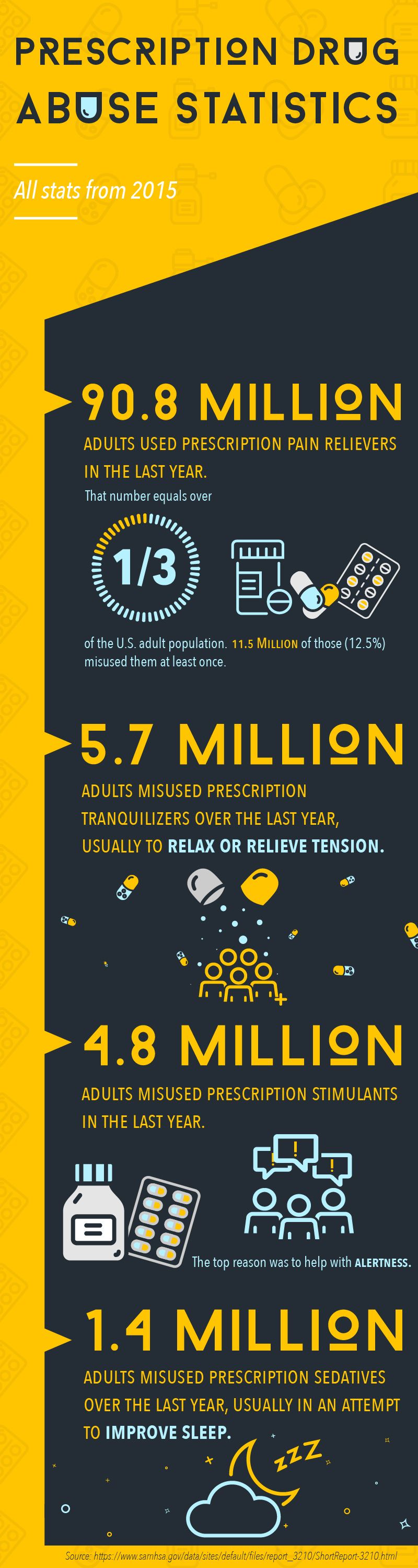
Prescription drug abuse is a significant problem in the United States. According to SAMHSA, while marijuana is the most commonly used controlled substance, prescription drugs are second on the list. While opioids are the most pressing issue regarding the abuse of prescription drugs, Americans regularly abuse other types of prescriptions as well. Prescription drug abuse statistics can reveal a lot about the scale of the problem.
Abuse of Prescription Pain Relievers
SAMHSA reports that about 91.8 million American adults used prescription pain relievers, including opioids, in 2015. That number is over one-third of the adult population. Clearly, the use of prescription pain relievers is pervasive in our culture.
Of those that used the pain relievers, 12.5% admitted to misusing the substance at least once within the past year. Experts define misuse as using a drug in a way that goes against the prescriber’s instructions on the label, or using drugs that a doctor prescribed to someone else. While the percentage of people that misuse their pain relievers may seem small, it amounts to 11.5 million people. That’s certainly not insignificant.
The most popular reason for the misuse of prescription pain relievers was to relieve physical pain. Even though this is the intended purpose of the drug, it’s still considered abuse to use the substance in an off-label way.
Misuse of Other Prescription Drugs
While the abuse of prescription pain relievers is the most significant problem, prescription drug abuse statistics show that Americans commonly abuse other types of drugs, too. For example, in 2015, about 5.7 million adults admitted to misusing prescription tranquilizers at least once within the last year. This category of drugs includes benzodiazepines like Xanax, as well as muscle relaxers. Tranquilizers being depressants, respondents most commonly cited the desire to relax as the reason behind their off-label use.
Sedatives are another example of depressant prescription drugs. Their most common use is to improve the quality of sleep in those who have insomnia. Of the 18 million adults that reported using a sedative in 2015, 1.4 million of them misused them, usually to help with sleep.
On the other side of the coin are prescription stimulants, which people most often abuse to stay awake or increase alertness. Of the 15.4 million adults that used prescription stimulants, 4.8 million of them reported misusing their prescription at least once.
What Do These Prescription Drug Abuse Statistics Mean?
The biggest takeaway from these statistics is that while abuse of prescription pain relievers is the most significant issue regarding prescription drug abuse, people should not ignore the misuse of other types of prescriptions. The number of people that admit to abusing prescriptions of all kinds is significant. It’s important to know these prescription drug statistics to get drug abusers the help that they need.
Help for Prescription Drug Abuse
If you or a loved one is one of the millions of Americans that struggle with prescription drug abuse, prescription drug addiction rehab is available at Driftwood Recovery. Our drug rehab programs include:
- Xanax addiction rehab
- Opioid addiction rehab
- Opiate addiction rehab
- Benzo addiction rehab
- Morphine addiction rehab
Don’t put off reaching out for help. Without the guidance of trained professionals, issues with addiction only get worse. Call Driftwood Recovery today at 866-426-4694 to learn more about how our programs can help you.
Prescription drug abuse is a significant problem in the United States. According to SAMHSA, while marijuana is the most commonly used controlled substance, prescription drugs are second on the list. While opioids are the most pressing issue regarding the abuse of prescription drugs, Americans regularly abuse other types of prescriptions as well. Prescription drug abuse statistics can reveal a lot about the scale of the problem.
Abuse of Prescription Pain Relievers
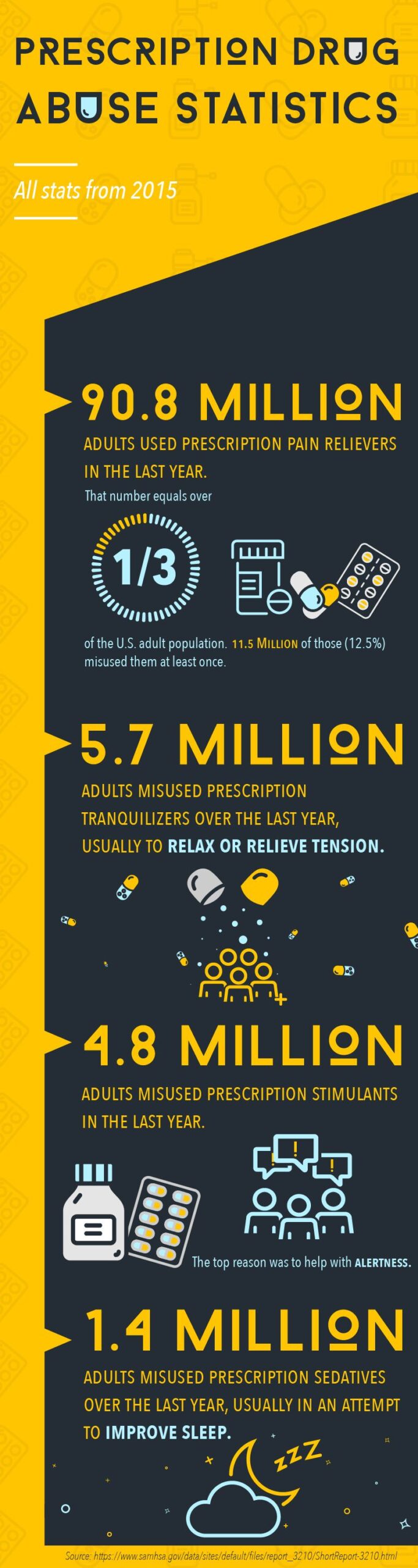
SAMHSA reports that about 91.8 million American adults used prescription pain relievers, including opioids, in 2015. That number is over one-third of the adult population. Clearly, the use of prescription pain relievers is pervasive in our culture.
Of those that used the pain relievers, 12.5% admitted to misusing the substance at least once within the past year. Experts define misuse as using a drug in a way that goes against the prescriber’s instructions on the label, or using drugs that a doctor prescribed to someone else. While the percentage of people that misuse their pain relievers may seem small, it amounts to 11.5 million people. That’s certainly not insignificant.
The most popular reason for the misuse of prescription pain relievers was to relieve physical pain. Even though this is the intended purpose of the drug, it’s still considered abuse to use the substance in an off-label way.
Misuse of Other Prescription Drugs
While the abuse of prescription pain relievers is the most significant problem, prescription drug abuse statistics show that Americans commonly abuse other types of drugs, too. For example, in 2015, about 5.7 million adults admitted to misusing prescription tranquilizers at least once within the last year. This category of drugs includes benzodiazepines like Xanax, as well as muscle relaxers. Tranquilizers being depressants, respondents most commonly cited the desire to relax as the reason behind their off-label use.
Sedatives are another example of depressant prescription drugs. Their most common use is to improve the quality of sleep in those who have insomnia. Of the 18 million adults that reported using a sedative in 2015, 1.4 million of them misused them, usually to help with sleep.
On the other side of the coin are prescription stimulants, which people most often abuse to stay awake or increase alertness. Of the 15.4 million adults that used prescription stimulants, 4.8 million of them reported misusing their prescription at least once.
What Do These Prescription Drug Abuse Statistics Mean?
The biggest takeaway from these statistics is that while abuse of prescription pain relievers is the most significant issue regarding prescription drug abuse, people should not ignore the misuse of other types of prescriptions. The number of people that admit to abusing prescriptions of all kinds is significant. It’s important to know these prescription drug statistics to get drug abusers the help that they need.
Help for Prescription Drug Abuse
If you or a loved one is one of the millions of Americans that struggle with prescription drug abuse, prescription drug addiction rehab is available at Driftwood Recovery. Our drug rehab programs include:
- Xanax addiction rehab
- Opioid addiction rehab
- Opiate addiction rehab
- Benzo addiction rehab
- Morphine addiction rehab
Don’t put off reaching out for help. Without the guidance of trained professionals, issues with addiction only get worse. Call Driftwood Recovery today at 866-426-4694 to learn more about how our programs can help you.
People often refer to addiction as a family disease. That’s because the development of addiction is frequently rooted in family issues. Plus, addiction can often run in the family. Take a closer look at the connection between addiction and family as well as the need for family therapy in rehab.
The Genetic Factors That Lead to Addiction
There is a myriad of factors that can contribute to the development of a substance abuse disorder. Many of them have to do with the individual and his or her mental health, history, and life experience. However, there is also evidence to suggest that addiction can be genetic.
This does not mean that some people have addiction in their DNA. What it does mean is that some people are genetically predisposed to develop addictions to substances faster. That explains why two men can drink the same amount of alcohol, but one will become addicted much faster than the other. This also explains why multiple family members may all struggle with addiction.
Underlying Issues Can Impact the Entire Family
While genetics is one factor that links addiction and family, shared history is another factor that you should consider. It is normal for family members to share serious life experiences. If multiple family members live through the same traumatic events, then they are collectively at greater risk for addiction.
If several siblings all live through a natural disaster, for example, then they all have a higher chance of developing an addiction. The same is true if the whole family witnesses a violent crime or watches a loved one die. Although just one family member might struggle with addiction as a result, the others may still need support and treatment for the shared underlying issue.
One Case of Addiction Can Disrupt the Family Dynamic
Addiction is also a family concern because one family member’s struggle can disrupt the entire family. When a loved one struggles with drug or alcohol addiction, it is tough to know how to help. The whole family might be tense, anxious, and worried about the future.
It is also common for communication to break down when one person is dealing with an addiction. Fortunately, family therapy can bring together loved ones. A counselor can mediate, teach family members about addiction, and help rebuild broken bonds.
Understanding Addiction and Family in Rehab
Addiction and family are linked, so it makes sense that family members should be a part of rehab. At Driftwood Recovery, our family program identifies the need for comprehensive, all-inclusive care. In addition to family therapy, Clients can expect a wide range of treatments. Some of these treatments may include the following:
- Trauma therapy
- Cognitive behavioral therapy
- 12 Step program
- Yoga therapy
- Experiential therapy
Addiction can impact the entire family in a variety of ways. At Driftwood Recovery in Texas, rehab programs heal the Client as well as the family. If you’re ready to fight back against addiction and rebuild your health, happiness, and sobriety, then call 866-426-4694 to learn more.
Pain is largely considered to be a physical condition. Anxiety, on the other hand, is largely considered to be a mental health condition. However, the two conditions can often overlap. Let’s look at the connection between anxiety and pain as well as how therapists can address them at the same time.
Anxiety and Muscle Tension
Think back to the last time that you felt anxious. Then, think about your body language. There’s a good chance that you were physically tense rather than open and relaxed. Anxiety commonly leads to muscle tension, which can then become a source of pain.
When muscles are tense for extended periods of time, they are more likely to become sore. Individuals who struggle with shoulder pain, neck pain and migraines, for example, might also be dealing with added tension caused by anxiety. While relaxing is a great way to eliminate that muscle tension, anxiety makes it hard to do.
Anxiety and Hypersensitivity
Anxiety and pain share close ties thanks to hypersensitivity. When people struggle with anxiety, they are also more likely to be hypersensitive to physical sensations. When they have an upset stomach, they are more in tune with those uncomfortable feelings. This means that some people with anxiety don’t actually have more physical pain, but they do experience and feel that pain in a more pronounced way.
One of the most common forms of pain among those with anxiety is joint pain. It may be true that those with anxiety can feel the inflammation in their joints more than the average person, leading to greater pain.
Behavioral Changes Created by Anxiety
Sometimes, pain can result from changes in behavior that are directly caused by anxiety. People who slouch or hunch their shoulders, for example, are more likely to have back and shoulder pain. Others may sleep in strange positions to cope with anxiety, but those positions may lead to physical pain.
Pain and Injury Can Also Lead to Anxiety
Typically, people think of anxiety as the precursor to pain. However, the opposite relationship is also true. Sometimes, the pain from an injury or an accident can cause a person to become anxious.
An athlete, for example, might be anxious about recovering from an injury. They can develop anxiety because of pain, and that anxiety may, in turn, cause the pain to feel worse. This creates a terrible cycle that might be hard to break out of.
Treating Anxiety and Pain at Driftwood Recovery
At Driftwood Recovery, Clients can overcome pain by tackling the source. In many cases, anxiety is one of the causes of chronic or acute pain. Treatment is holistic, approaching the Client as a unique individual. Some treatment methods to combat anxiety and pain include:
- Yoga therapy
- Cognitive behavioral therapy
- Physical therapy
- Dialectical behavioral therapy
- Dual diagnosis support
Anxiety treatment may be one way for Clients to reduce or eliminate pain. At Driftwood Recovery in Texas, you can find the right kind of support and improve your quality of life. Call 866-426-4694 to learn more.
Texas faces unique challenges when it comes to drug abuse. According to the Texas Department of Public Safety, Texas is in the direct path of cartels looking to traffic illegal substances into the United States. From cocaine to marijuana to heroin, Texas drug statistics show that the state is a popular route for drugs entering the country.
Interestingly, this activity also results in trends in drug treatment admissions along the border that differ from those further north.
Along the Border
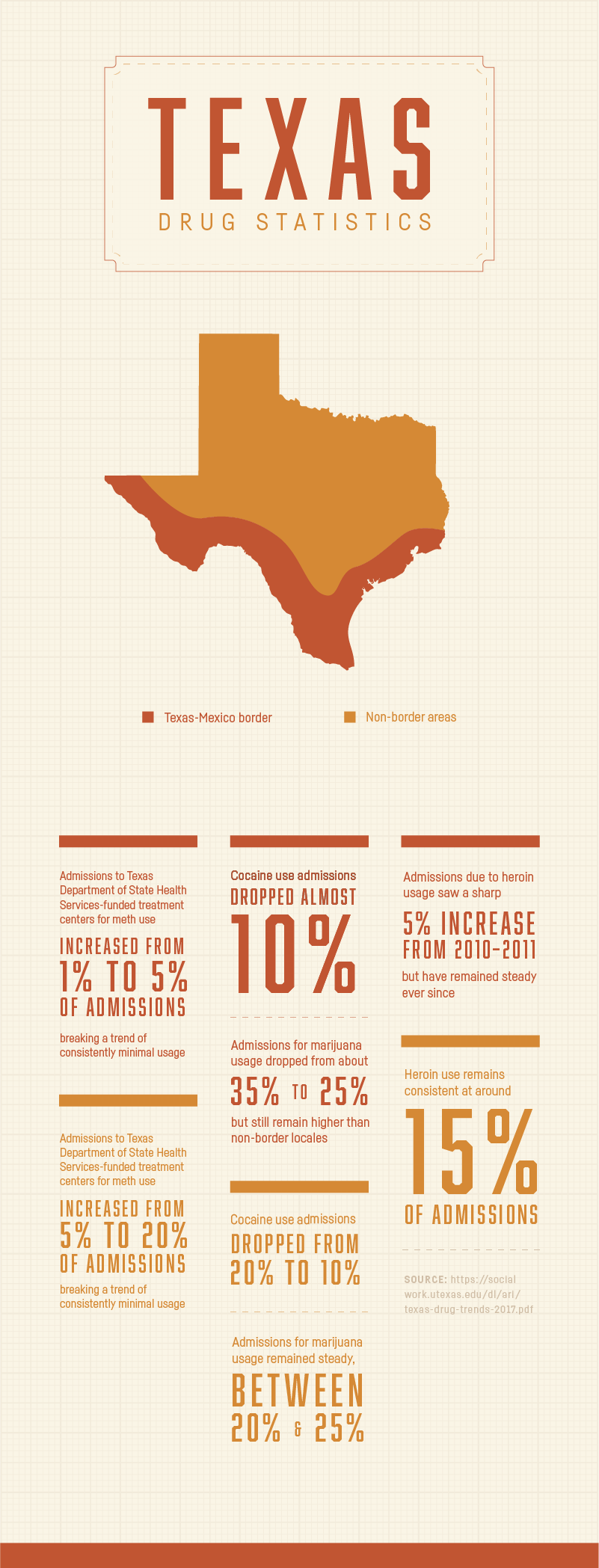
Admissions to drug addiction treatment centers funded by the Texas Department of State Health Services (DSHS) can tell us a lot about the trends of drug use throughout the state. For example, admissions due to marijuana use are consistently higher along the Texas border than in other parts of the state.
However, admissions for methamphetamine use are almost nonexistent along the U.S.-Mexico border. Texas drug statistics show that the drug of choice in this region tends to be marijuana, followed by heroin and cocaine.
Further North
Admissions to Texas DSHS-funded addiction treatment centers tell a different story about areas of Texas north of the border area. Marijuana does remain the culprit behind the majority of admissions. However, methamphetamine usage is not far behind. In areas north of the border, people seeking treatment for meth abuse is more common than that for heroin.
In fact, most of Texas has largely evaded the worst of the heroin epidemic that’s ravaging states further north. This is because of the prevalence of Mexican Black Tar heroin. This type of heroin makes up the majority of heroin used in Texas. Mexican Black Tar is lower in purity than the heroin found in the northeast. It also doesn’t mix well with fentanyl, which is the synthetic opioid that’s causing increased numbers of overdoses. Notably, when authorities find fentanyl in Texas, it’s more frequently mixed with benzodiazepines and other opiates. Only 3% of Texas heroin deaths involve fentanyl.
What Do These Texas Drug Statistics Mean?
With all of these Texas drug statistics, you may be wondering what it all means. Essentially, the substance abuse situation in Texas is complex. Due to its size and proximity to a drug trafficking hotbed, drug use trends can vary greatly by region. For this reason, there’s no one single solution to Texas’ drug problems.
Help for Drug Addiction at Driftwood Recovery
One way to chip away at the problem of drug abuse in Texas is to encourage users to seek treatment. At Driftwood Recovery, we have the tools to treat everything from prescription drug abuse to methamphetamine abuse. Some of the services we provide for our clients include:
- Dual diagnosis treatment
- Alcohol rehab program
- Group therapy
- Family program
- Trauma therapy
- Yoga therapy
Don’t let Texas drug statistics scare you. Addiction is treatable. You just have to take the brave first step and reach out for help. Call Driftwood Recovery at 866-426-4694 today.
[Source]
Contact us

Break the cycle of suffering through surrender.
Contact Driftwood Recovery today to get more information or schedule a tour.